▸ note01
Content as data
Texts, projects, skills and experience live in content/*.ts. Pages are server components prerendered to static HTML — a new case study is one more object in a list.
guest@gubanov:~$ cat ./projects/portfolio/README.md
This very site — built from an empty Next.js project, prompt by prompt, with Claude Opus 5.5.
I set the direction, gave the content and reviewed every step; the code, the deployment, the screenshots and the case texts were produced by Claude Opus 5.5 in Claude Code. Below is the full log — what each prompt asked for and what came out of it.
// context
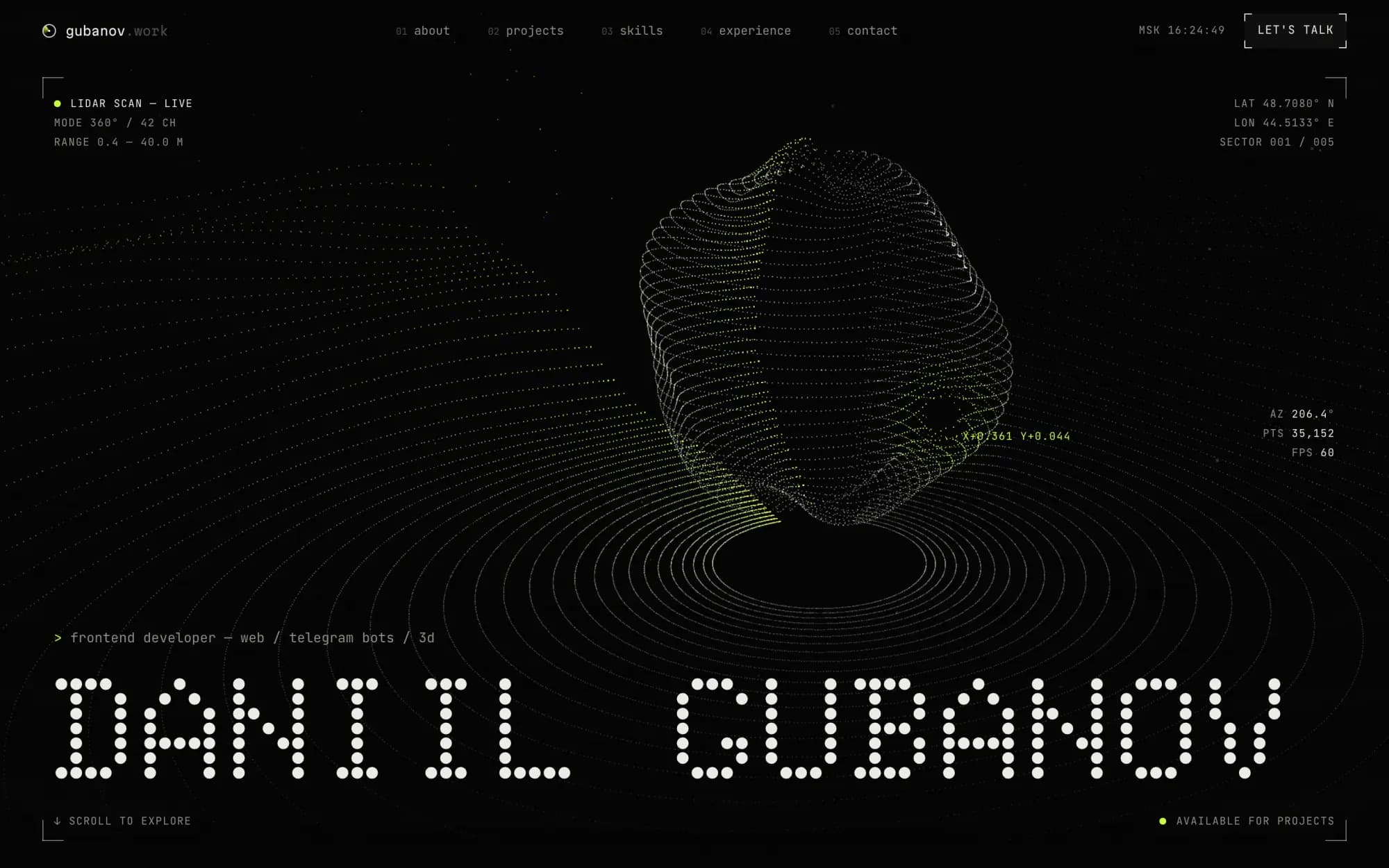
A developer portfolio in a terminal-and-lidar aesthetic: a WebGL point cloud swept by a scanning beam, dot-matrix type, headings that decode themselves and sections that open with a shell command.
It is also an experiment: how far one developer gets with an AI agent when the prompts are short and concrete. Every prompt in the log below is real — together they took the project from an empty Next.js app to a deployed site with case studies, on a VPS with its own domain.
Counted from the Claude Code session logs: every model call with its input, cached context and output.
prompt 01
109 calls · 25.5M tokens · 216K out
meAn empty Next.js project and a reference site for mood. Build a unique developer portfolio home: an abstract hero, about, three featured projects, skills, work experience and contacts. Terminal and lidar style, smooth text, reveal and hover animations; placeholders for the content.
opusThe whole home page: a boot screen, the WebGL lidar hero with a cursor probe, decoding headings, a neofetch card with an ASCII torus, project cards with generated previews, skills with level bars, experience as a git log, a working terminal in the contact block and a vim-style status line.
prompt 02
13 calls · 0.6M tokens · 10K out
meUpload the site to the VPS, connect the gubanov.work domain and prepare subdomains for future projects — oriby, panamax, taskmanager.
opusA standalone build shipped with rsync and run by systemd behind nginx, virtual hosts for the domain and three subdomains, one Let's Encrypt certificate for all five names. The root-level steps were packed into one script that I ran myself; a deploy script appeared for later updates.
prompt 03
11 calls · 0.9M tokens · 11K out
meHere is my resume as a PDF — study it, rewrite the site's texts based on it and deploy the update.
opusName, role, location, contacts, the about text, skills and four jobs taken from the resume and translated to English. All the placeholders are gone.
prompt 04
72 calls · 17.4M tokens · 132K out
meMention Next.js and Nuxt in About, change skill levels and add AI agents, show months in the experience, fix the cursor that overlapped the system one, and present Oriby and Task Manager as projects.
opusTenure counted automatically, the hero crosshair turned into a native SVG cursor, case pages with screenshots taken in headless Chrome, a full-screen viewer and the Oriby Lighthouse results; the Oriby demo went live on its subdomain.
prompt 05
50 calls · 20.2M tokens · 46K out
meRename gubanov.dev to gubanov.work, add this site as a project with the AI log, link the GitLab repositories, refresh the Task Manager case and push everything to GitLab.
opusThis page with statistics from the Claude Code logs, new English screenshots of Task Manager, repository links on every case and the code on GitLab.
prompt 06
41 calls · 19.9M tokens · 54K out
meMake the history collapsible, add a live demo and the start date to Task Manager, Telegram and GitLab to the contacts, and four 3D models to the projects page — rotatable in 3D without breaking the style, maybe as a lidar scan.
opusEach FBX model sampled into a 120K-point cloud and shown in a hand-written WebGL viewer: a scanning beam, drag to rotate, intensity and rgb modes. Projects split by direction, the Task Manager demo on its subdomain, new contacts, this collapsible history.
All of it through the prompts; my part — the brief, the content and the review.
Home page: a WebGL lidar hero, about with a neofetch-style card, featured projects, skills with levels, experience as a git log and a contact block with a working terminal (help, whoami, projects…).
Motion without animation libraries: one IntersectionObserver for reveals, text scramble, typewriter, dot-matrix letters, Lenis smooth scrolling and prefers-reduced-motion support.
Content from the resume: about, skills with levels, experience with months and tenure calculated automatically.
Case study pages generated from one data file, a full-screen screenshot viewer and a projects archive.
Screenshots of the projects taken automatically in headless Chrome — desktop and phone, light and dark themes.
Production on a VPS: nginx, systemd and Let's Encrypt for the domain and project subdomains, plus a one-command deploy script.
Click a screenshot to open it full screen; arrow keys switch between them.
▸ note01
Texts, projects, skills and experience live in content/*.ts. Pages are server components prerendered to static HTML — a new case study is one more object in a list.
▸ note02
The hero is a hand-written shader: a point cloud, a scanning beam and a cursor probe in a few hundred lines. Rendering pauses when the hero leaves the screen.
▸ note03
The hero crosshair is a native SVG cursor instead of an overlay that lags behind the mouse; the screenshot viewer is a <dialog> with Esc and focus return for free.
▸ note04
Next.js output: standalone is built on the laptop and shipped with rsync — the 1.6 GB VPS only runs node server.js behind nginx.
Next.js 16
App Router, static prerendering
React 19
server and client components
TypeScript
strict mode
Tailwind CSS 4
design tokens in @theme
WebGL
hand-written shaders for the hero
Lenis
smooth scrolling
nginx, systemd
VPS, Let's Encrypt
Claude Code
Opus 5.5 as the pair programmer