▸ note01
Feature-Sliced Design
The code is split into app / pages / widgets / shared layers. Every section of the landing is a self-contained widget with its own markup, CSS Module and motion.
guest@gubanov:~$ cat ./projects/oriby/README.md
Website for a design-only studio — from Figma mockups to a fast React frontend.
I designed the site and built its frontend; a teammate made the backend that receives leads. In 2026 I came back and made the page 14× lighter without touching the design.
// context
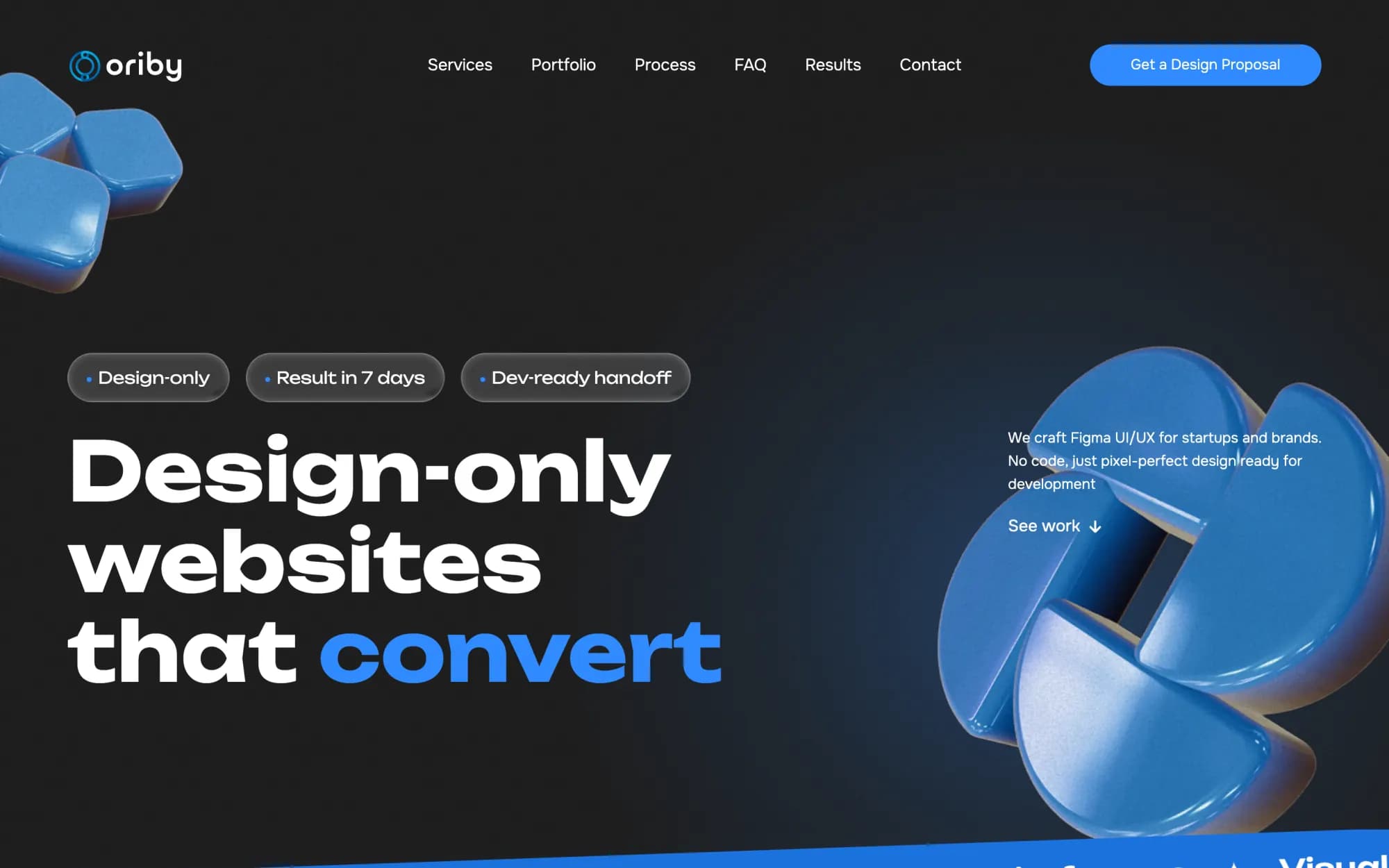
Oriby is a design-only studio: it crafts UI/UX in Figma for startups and brands and hands developers ready-to-build files. The site had to sell exactly that — look premium, explain the workflow in a few screens and turn visitors into requests.
I designed it in Figma and built the frontend on React + TypeScript: one landing page with services, portfolio, process, FAQ, results and a contact form, plus confirmation and 404 pages. The form sends leads to the studio's backend through a REST API.
Design and frontend are mine; the backend and the lead API — my teammate's.
Designed the site in Figma: layout, 3D visuals, desktop and mobile versions.
Built the frontend on React 19, TypeScript and Vite, structured by Feature-Sliced Design.
Animated it with Framer Motion: the hero title slides in line by line, 3D shapes follow scroll and cursor, the header turns into a glass pill with a progress bar, cards light up under the cursor and numbers count up.
Connected the lead form to the backend REST API: validation, phone formatting, inline errors and a confirmation page.
Made it responsive from 320 to 1440 px and accessible: keyboard navigation, ARIA for the menu and FAQ, fixed contrast, prefers-reduced-motion support.
Ran a performance pass: WebP images with srcset, subset WOFF2 fonts, form libraries loaded on demand, vendor chunks for caching.
Click a screenshot to open it full screen; arrow keys switch between them.
▸ note01
The code is split into app / pages / widgets / shared layers. Every section of the landing is a self-contained widget with its own markup, CSS Module and motion.
▸ note02
Only transform and opacity are animated, framer-motion is loaded through LazyMotion and scroll effects are computed outside React — scrolling holds 60 fps even with a 4× CPU slowdown.
▸ note03
PNG → WebP sized for the screen with srcset. A 2 MB grain texture became a 7 KB tile, 900 KB of TTF became 33–59 KB variable WOFF2 subsets with preload.
▸ note04
axios and libphonenumber-js arrive only when the visitor starts filling in the form, images below the fold wait for the page load, vendor libraries live in cacheable chunks.
Performance pass, 2026. Lighthouse 12, production build, gzip. Mobile profile — slow 4G and a throttled CPU.
| metric | before | after |
|---|---|---|
| Performance, mobile | 66 | 91 |
| Performance, desktop | 95 | 100 |
| Accessibility, mobile / desktop | 85 / 81 | 96 / 96 |
| Best Practices | 96 | 100 |
| SEO | 67 | 100 |
| First Contentful Paint, mobile | 3.9 s | 1.7 s |
| Largest Contentful Paint, mobile | 8.0 s | 3.5 s |
| Page weight | 6.3 MB | 0.46 MB |
| JS on load, gzip | 171 KB | 115 KB |
| ESLint errors | 20 | 0 |
React 19
interface
TypeScript
typed components and API client
Vite 7
dev server, build, vendor chunks
React Router 7
routes /, /confirm and 404
Framer Motion 12
animations through LazyMotion
CSS Modules
component styles
axios, libphonenumber-js
lead form, loaded on demand
Figma
design and handoff